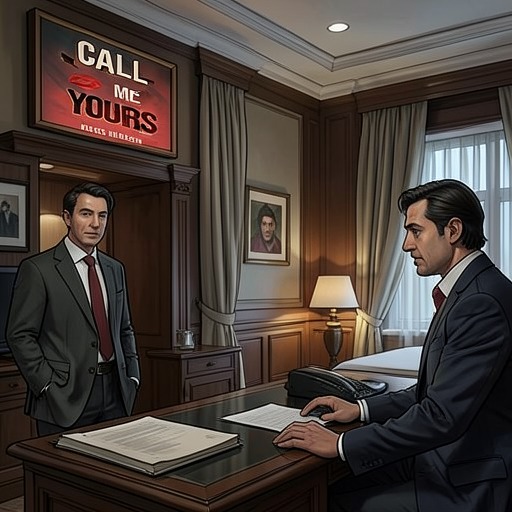
Blake Anderson
Call Me YoursBlake Anderson is introduced as the new operations manager of Morrison Group of Hotels, but his decisive narrative function is more unsettling than administrative. He enters the story as a figure of order whose scrutiny quickly becomes a form of menace. His rigid rules, persistent observation, and growing obsession with Kayla Morrison make him a human instrument of surveillance: he watches, classifies, and intrudes, turning the hotel’s workplace and surrounding social spaces into places where concealed histories may be exposed.
Identity and Introduction
Blake Anderson has been employed by Kayla Morrison for less than four weeks when she realizes that she has neglected to fire him. His presence produces an immediate physical reaction in her: her heart races, a chill runs down her spine, and her skin crawls whenever she sees him. The narrative gives him a sharply defined appearance. He is fifty years old, with a grizzled ginger beard, a craggy face marked by rugged lines, and ginger hair combed into a slicked-back pompadour with a side part. His gray tailored suit, black shoes, and matching bowtie project controlled professionalism, while the precision of that presentation makes his intrusion feel more deliberate rather than more reassuring.
Kayla notices that Blake appears to keep his distance, yet she has caught him staring at her more than once. His gaze seems to her capable of seeing into her soul, a particularly dangerous quality because she does not want anyone investigating her past. Her fear is not merely that Blake is unpleasant; she believes that the discovery of what she has concealed could end her life. His first significance therefore lies in the contradiction between surface respectability and the threat attached to being seen by him.
Authority and Workplace Conduct
At a staff meeting, Jessica Cooper formally introduces Blake as the new manager and gives him the floor. Blake presents himself through professional credentials, claiming nearly thirty years of experience in hotel management and previous management of two five-star hotels. He says he is pleased to join Morrison Group of Hotels, then immediately defines his authority through intolerance. Idleness, gossip, indolence, unpunctuality, and a lack of good grace are all singled out as offenses, and he announces that anyone who breaks his rules will be shown the way out.
His speech frames diligence as the condition for survival under his management. Blake promises that employees who work hard will get along with him, but the reassurance is subordinate to the threat of expulsion. He also announces that he will establish new rules and that every employee must obey them. The meeting thus makes his managerial style concrete: he does not enter as a neutral administrator learning the institution, but as a disciplinary presence intent on reorganizing it according to his own standards.
The performance of authority becomes personal when Blake points at Chris Davis and demands his name, then asks Jessica what Chris’s job is. The exchange is brief, but it shows Blake sizing up an employee in public rather than simply receiving an introduction. His attention moves from general policy to individual classification, establishing the pattern that later governs his encounters with both Chris and Kayla.
Surveillance and Suspicion
Blake’s gaze affects Chris Davis as strongly as it affects Kayla. At Cocomo Café, Chris raises his cup and meets Blake’s eyes across the room. Blake stares at him as though Chris possessed an extra eye in the middle of his forehead, and although the café is open to everyone, Blake’s presence makes the place feel contaminated. Blake turns away before Chris can acknowledge him, leaving the encounter suspended between deliberate avoidance and unmistakable observation.
Chris cannot decipher the expression in Blake’s eyes, but he concludes that Blake is up to no good and becomes cautious around him. This response develops Blake’s role beyond that of an unpleasant employer. His power comes less from an openly stated accusation than from the uncertainty produced by his attention. He need not confront Chris to make Chris feel watched; the stare itself becomes a pressure that alters Chris’s behavior.
That suspicion acquires a more concrete shape when Nolla is asked whether she would recognize a mysterious man if she saw him again. She identifies the man across the room as the one with red hair, although Blake is standing at the counter with his back turned. Her description matches Blake’s appearance. The recognition causes a vein to twitch in his cheek and stiffens his entire body, a visible reaction that intensifies the implication that his presence is connected to the unidentified figure. The text does not resolve the mystery within these scenes, but it makes Blake’s resemblance central to the reader’s suspicion and links his controlled exterior to a concealed danger.
Obsession with Kayla Morrison
Blake’s professional interest in Kayla develops into private fixation. In his bedroom and living room, with soft classical music drifting from the bedroom, he sits with a laptop on his thighs and searches for Kayla Renae Morrison on Google while holding a burning cigarette in his other hand. His girlfriend, Cleo, is on his bed, yet another woman consumes his thoughts. The physical arrangement exposes the emotional displacement: even in an intimate domestic setting, Blake’s attention is directed elsewhere.
He is described as becoming obsessed with his new boss and unable to stop thinking about her. Kayla intrigues him because of an aura of mystery that he has not been able to crack. The language of cracking a mystery turns a person into a problem to be solved. Blake’s desire is not presented as mutual intimacy or ordinary admiration; it is organized around access, investigation, and the conquest of an unknown interior. Kayla’s secrecy attracts him precisely because it resists his scrutiny.
This private search also mirrors his behavior at the hotel. In public, he studies people through silence and staring; in private, he uses the search engine to pursue information about Kayla. The contrast between the laptop and the gaze is important: one is technological and one is bodily, but both perform the same action of turning Kayla into an object of examination. His obsession therefore extends the disciplinary persona announced at the staff meeting into a personal attempt to possess knowledge of her life.
Connection to Kayla’s Hidden Past
Kayla’s fear of Blake is intensified by the possibility that he may discover something capable of ending her life. She does not simply dislike his appearance or management style; she experiences him as someone who might penetrate the boundary protecting her concealed identity and history. Blake’s apparent ability to look into her soul gives his attention an almost invasive psychological force, while his own motives remain partly withheld.
The recurring pattern is one of mutual asymmetry. Kayla knows that Blake unsettles her and that she has failed to dismiss him, but she cannot yet explain the full source of his threat. Blake, meanwhile, is drawn to her because she remains mysterious, and his inability to understand her intensifies rather than limits his interest. The more Kayla wants her past left undisturbed, the more her secrecy appears to stimulate Blake’s investigation.
Their confrontation in the hotel break room makes the suspicion materially specific. Kayla smells cigarette smoke while passing the break room, enters instead of going to the restaurant, and finds Blake smoking at the window. When she clears her throat, he whirls around and drops the cigarette. Kayla picks it up and recognizes it as the same brand as the cigarettes she found in the woods. The dropped cigarette turns Blake’s atmosphere of menace into a possible physical link with earlier suspicious circumstances, while his startled reaction suggests that the encounter has caught him off guard.
Narrative Role and Significance
Blake Anderson functions as an embodiment of the gaze that Kayla most fears: an outsider who does not accept appearances and whose attention threatens to convert secrets into evidence. His managerial language of rules and dismissal establishes institutional power; his staring extends that power into interpersonal intimidation; his Google search reveals its private, obsessive form. Across these modes, he repeatedly positions himself as the person who decides what must be examined, classified, corrected, or exposed.
The character’s tension comes from the gap between his formal credentials and the unease surrounding him. A gray suit, decades of hotel experience, and claims of professional discipline give him an acceptable public identity, yet the narrative places that identity beside compulsive staring, suspicious bodily reactions, cigarette traces, and fixation on Kayla. Blake is therefore not merely a strict manager. He is a destabilizing presence whose authority supplies cover for inquiry, whose curiosity becomes obsession, and whose attention threatens to make the hidden past visible.